Notes from the Trenches: Strategic Wisdom from Lead Dev London 2016
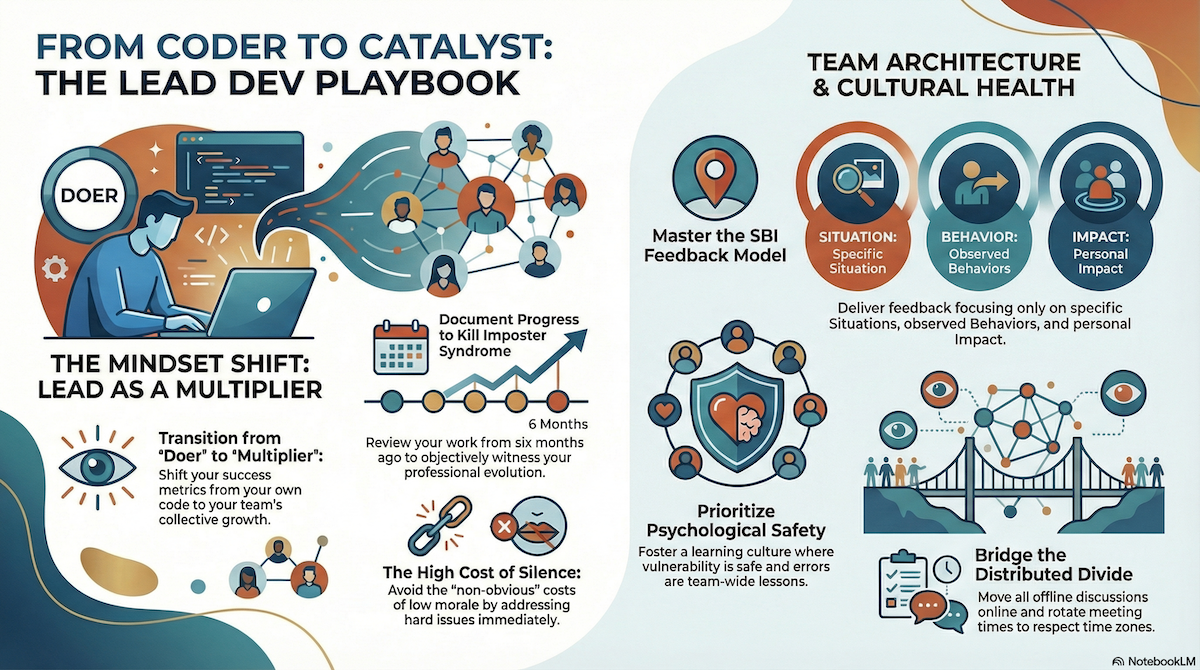

I’ve just finished digging through the insights from Lead Dev London, and honestly, it’s a goldmine for anyone stepping up into technical leadership. The most vital realization here is that the “Lead Dev” role isn’t just a title change for a senior coder; it’s a fundamental shift in your very identity. You are no longer a solo contributor measured by your personal throughput; you are now a multiplier of talent. Your success is no longer about how well you build systems, but how well you build the people who build those systems.
Throughout the conference, a few core themes kept rising to the surface: the absolute necessity of psychological safety, the power of rigorous feedback loops, and the importance of intentional culture-building. We often think of culture as “perks” or HR fluff, but these sessions make it clear that culture is the operating system of your team. If you get the human systems right—by fostering trust and embracing diverse perspectives—the technical excellence tends to follow as a natural byproduct.
1. The Internal Journey: Mastering the Mindset of a Lead
Making the jump from a code-focused developer to a people-focused lead is the hardest architectural shift you’ll ever face. When you’re at the keyboard, feedback is instant (the tests pass or they don’t). In leadership, feedback is delayed by weeks. I remember my first lead role—I was so terrified of losing my “technical edge” that I insisted on reviewing every single PR and rewriting half of them. I thought I was maintaining quality, but I was actually suffocating the team and burning myself out. I was stuck in the “Iceberg Illusion,” looking at other successful leads and only seeing their output, while ignoring the persistence and failures happening under the water.
Many of us hit what Patric Kua calls the “Rocky Path,” feeling like an imposter the moment we stop writing code all day. You have to realize your job has changed to four specific tasks: information gathering, abstraction, filtering, and delivery. You also have to accept that you won’t be a hero to everyone; remember the old fable of the man, the boy, and the donkey—if you try to please every stakeholder and dev, you’ll end up losing your way.
To navigate this, lean into the Situational Leadership model. Depending on the person and the task, you need to navigate between Sell, Tell, Participate, and Delegate. Don’t do this in a vacuum, though. Own your growth by building a support network of peers outside your immediate team. Once you stop trying to be the smartest person in the room and start being the person who makes the room smarter, you’re ready to manage the humans around you.
2. Building High-Performance Teams: Culture as a Product
We need to stop treating team culture like an afterthought. It is a deliberate system that dictates productivity. As Camille Fournier and Duretti Hirpa pointed out, you are essentially choosing between a Culture of Trust and a Culture of Fear. High-performance teams run on Psychological Safety. This isn’t just about being “nice”; it’s about creating a space where vulnerability is safe and reporting an error is a learning moment, not a death sentence. As Duretti puts it: “Productivity is a measure of comfort.”
Here is where most people trip up: the “habitus” bias. It’s that subconscious voice saying, “He reminds me of a younger myself.” When we hire people who look and think like us, we aren’t just failing at diversity; we are failing at strategy. A team of clones has the same blind spots. Diversity is a strategic necessity because it brings the varied perspectives required to solve complex, non-binary problems.
Think of software as a “team sport” and your role as the captain. Nikolas Means shared a powerful lesson from the United 232 plane crash: the crew survived a “survivable” crash because of Crew Resource Management. The captain surrendered the “hero myth” and used his authority to ensure every voice in the cockpit was heard. In our world, that means giving engineers the space to make mistakes and grow. When a team feels safe and heard, they communicate more effectively, creating the robust feedback loops necessary for excellence.
3. The Mechanics of Feedback and Communication
In Systems Theory, as Dan North explains, feedback is the control system of an adaptive organization. Without it, you’re just flying blind. But many of us are doing it wrong. We’ve all been taught the “Sandwich” method, but it often confuses the message. A much better tool is the SBI model:
- Situation: Be specific about when and where.
- Behaviour: Describe what they did without judging words.
- Impact: Explain how it affected you or the team.
When you’re the one receiving feedback, there is only one correct response: “Thank you.” There is no step two.
We also need to “hack” our verbal communication. In meetings, we deal with “latency”—the delay between a thought and the chance to speak. This leads to “race conditions” where the loudest person wins the floor while others get marginalized. Some teams use hand signals (like those from the “Occupy Together” movement) to improve flow control without constant interruptions.
A Pro-Tip on Systems Theory: Think of your team as a series of loops:
- Reinforcing loops accelerate behavior (like a “shift the burden” addiction to hotfixes)
- Stabilizing loops move toward a goal (like healthy cooperation)
- Oscillating loops create “boom and bust” trashing (like a shower that’s too hot then too cold). Your job as a lead is to identify which loop your team is stuck in and adjust the “delay” to settle the system.
4. Operational Excellence: From Commits to Customers
Technical practices are actually forms of social communication. Your Version Control history is a gift to your future self. Joel Chippindale’s Three Principles of Commits are essential: make them atomic (one change per commit), write descriptive messages explaining why, and revise your history before sharing to tell a clear story. Code history is asynchronous communication; treat it with respect.
Beyond the code, we have to align with the customer’s reality. AWS uses a “Working Backwards” approach that is pure gold: before writing code, write a Mock Press Release, a set of FAQs, and create Mockups of the experience. Then, you iterate on these documents with stakeholders. If the press release doesn’t excite you, or the mockups don’t tell a compelling story, don’t build the product. It’s much cheaper to delete a paragraph than to refactor a microservice.
Finally, we have to fight burnout. Gill Zellner and Penny Wyatt remind us that leaders are “overhead” —- we exist to enable the value-creators. Use a knowledge matrix to map skills across the team so you only wake up the right person during an outage, rather than paging everyone. Most importantly, protect your team’s sleep. If someone has a “disaster” night on-call, give them a mandatory half-day off. We protect the human system so it can protect the technical one.
5. The Essential Takeaways: Your Lead Dev Cheat Sheet
- Normalize Vulnerability: Share your own “first-time lead” failures. If you show it’s safe to be human, your team will too.
- Commit Atomically: One change, one commit. It makes your history a searchable, readable story rather than a junk drawer.
- Say the Hard Things Early: The long-term cost of avoiding a difficult conversation is your own credibility and the team’s sanity.
- Surrender the Hero Myth: Your job isn’t to have the answer; it’s to use your authority to ensure the best answer is heard.
- Smash the Habitus Bias: If a candidate “reminds you of yourself,” be extra critical of your bias. You need perspectives you don’t already have.
- Fight for the Team’s Sleep: Automate the routine “yak shaving” and enforce rest after on-call shifts. Burnout is a management failure.
- Adopt the SBI Model: Focus feedback on specific situations and behaviors. It makes the critique about the work, not the person.
- Work Backwards: Write the Press Release and FAQs first. If you can’t define the value to the customer, you shouldn’t be writing the code.
6. Closing Thoughts
Stepping into leadership is a journey that never truly ends. You’ll make mistakes—I still do—but remember that your role is now about the “multiplier” effect. Your success is reflected in the growth and happiness of your team.
We didn’t get into the technical weeds of webhooks or AWS scaling today, as those are just tools for the belt. The real “secret power” of a lead is the ability to say “no” to the urgent in favor of the important. Focus on the human systems, be unfailingly kind, and the rest will fall into place.
Now, go build something great—and be kind to your team while you’re at it.
Réactions