The Engineering Leadership Playbook: Strategic Insights from LDX3 London 2025

I’ve just returned from the trenches of LDX3 London 2025, and the vibe is clear: the era of “measuring for the sake of reporting” is over. We are operating in a pressure cooker of rapid AI adoption, tighter capital, and the friction of remote-default cultures. In this environment, the “Million Dollar Bug” isn’t a ghost story—it’s a $5.4 billion reality for CrowdStrike and a $500 million nightmare for Sonos.
The most transformative blueprint from this year is the shift from tracking output to driving outcomes. Success now requires more than just stable teams; it demands a “fluid” architecture that can pivot quarterly without breaking. We must also stop talking about “Technical Debt” as a dev-only problem and start managing “Commercial Debt”—recognizing that every shortcut is a business-wide liability. This playbook is about moving from noise to insight, ensuring our engineering organizations aren’t just shipping code, but building sustainable, high-performing cultures that treat quality as a competitive weapon.
1. Reimagining Team Architecture: From Stability to Fluidity
We’ve long worshipped at the altar of “stable, long-lived teams,” fearing that any change triggers a productivity-killing “storming, forming, norming” cycle. I’ve seen enough “Technical Debt Death Spirals” to know that rigid silos are often where innovation goes to die. The LDX3 consensus is a pivot toward Demand-Led Planning.
The Demand-Led Model: In this framework, organizations of up to 200 people can reorganize quarterly. This isn’t chaos; it’s business agility. We shape the team to fit the demand, rather than shoehorning work into static boxes. The strategic core of this is an 8-step process, with the most critical being Step 2: Allocate Spend with a “No Zero Allowed” rule. This means you must fund discovery and Kaizen (continuous improvement) every quarter. You cannot allow “mandatory” BAU or delivery pressure to cannibalize the work that reduces long-term risk.
The Mobility Advantage: Internal mobility is your secret weapon for retention and throughput. The data is undeniable: employees stay 41% longer at companies with high mobility, and these organizations see a 13% boost in productivity. To build this, move beyond HR policies to “Team Swaps,” internal vacancies, and normalized “stay conversations.”
Strategic Constraint: The “Bumble Bee” Tactic: To manage fluidity without losing context, use “Bumble Bees”—individuals who float across teams to manage constraints. To keep this manageable, follow two hard rules:
- A single Bee can float across a maximum of 3 teams.
- A single team can host a maximum of 3 Bees. This ensures expertise flows without creating “bottleneck humans” or diluting team focus.
2. The New Metrics: Balancing Throughput with Developer Experience
Strong delivery metrics are often the “green lights” that hide a burning engine. If your dashboard shows high velocity but your best engineers are quitting, your metrics are lying to you. We need to move from reporting to leading.
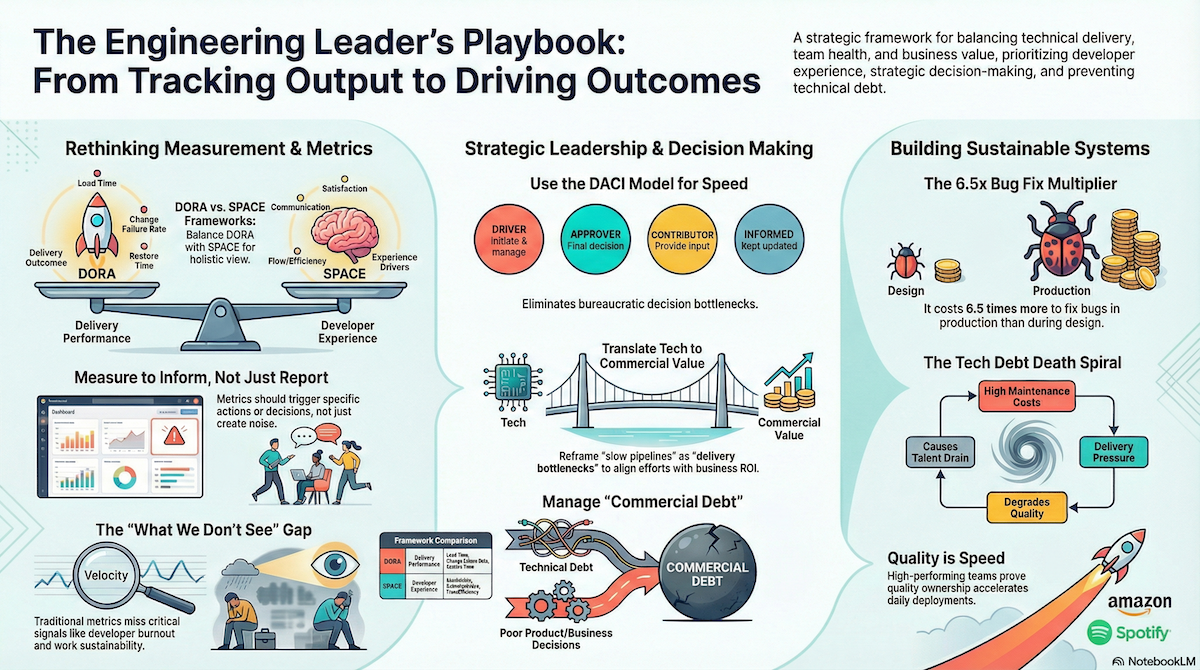
Outcome vs. Experience: The goal is to bridge the gap between what we track (DORA) and what we often fail to see (SPACE). Use the following table as a diagnostic tool for your next leadership review:
| What We Track (The Signal) | The “So What?” (The Diagnostic Questions) |
|---|---|
| Velocity & Story Points | Are we actually working on the right things, or just moving tickets? |
| Cycle Time | Are we reworking or getting blocked repeatedly by external dependencies? |
| Deployment Frequency | Is our current delivery pace actually sustainable, or are we “borrowing” from the future? |
| Change Failure Rate | Do developers feel focused and supported, or are they operating in a high-stress environment? |
From Insight to Action: Metrics only matter if they trigger the Signal-Insight-Action loop. For example, if you see a spike in cycle time (Signal), and your devs report they are stuck in review queues (Insight), your leadership action isn’t to “ask for more speed”—it’s to rebalance WIP limits and streamline the review process.
3. Quality as a Competitive Advantage: Debt, Risks, and “Million Dollar Bugs”
Quality is not a “nice-to-have” technical luxury; it is the heartbeat of speed. When you sacrifice quality, you aren’t moving faster—you are just taking out a high-interest loan. As we saw with the recent $5.4B CrowdStrike failure, a lack of quality is a business-killer.
The Mathematics of Failure: In the Technical Debt Death Spiral, delivery pressure causes quality to degrade. This leads to increased maintenance costs and “Talent Drain” as high-performers refuse to work in a “firefighting” culture. Eventually, you hit Blocked Investment, where innovation stops because you are 100% reactive. Remember: it is 6.5 times more expensive to fix a bug in production than during the initial design phase.
Technical vs. Commercial Debt: We must translate technical risk into the language of the Executive Committee (ExCo). As CTO or Director, your first team is the ExCo, not the engineering leads. Use Lee Provoost’s formula to explain this: Commercial Debt = sum(technical, product, business decisions) < now() * hustle. Commercial debt is the sum total of every shortcut that limits your future ability to pivot.
Actionable Takeaway: The Pre-Mortem Audit: Before any major release, ask:
- What quality assumption could destroy us if we’re wrong?
- What if the AI looks right but is confidently wrong?
- What is the earliest signal that this is going off the rails?
4. The Human-First Leader in the Age of AI
“Writing code is the easy part; working with humans is the difficult part.” In an era where AI can generate a thousand lines of boilerplate in seconds, our most valuable leadership metric is “Time to First Human.”
Mastering the “Manager of Managers” Shift: As you scale, you move from direct control to managing systems. This requires the 3 Ps:
- Perception: Diving into details to spot patterns across teams that others miss.
- Patience: Accepting a “temporal shift.” Wins take quarters to show, and problems are messier. In this role, “resolution” often means no one is perfectly happy, but everyone can tolerate the outcome.
- Presence: Being the “translator” who ensures the business understands the technical reality.
AI as a Force Multiplier: The “great lie” is that AI will replace the need for quality. In reality, AI is excellent for “raw power”—summarizing meetings, test coverage, and boilerplate code. However, it is a significant impediment in “weird” contexts, complex business decisions, and managing human feelings. Use AI to automate the rote, so you can spend your “human time” on coaching and empathy.
5. Strategic Lessons for 2025: Key Learnings
Building a high-performing team is about creating a unified Operating System (OS). Here are the blueprints for 2025:
- Fund the “No Zero” Rule: Quarterly planning must explicitly fund discovery and Kaizen. If you don’t fund the future, you won’t have one.
- Stop Tracking, Start Leading: If a metric doesn’t trigger a specific intervention (like adjusting WIP or adding focus time), stop collecting it.
- Scale the System, Not Firefighting: If you can’t scale firefighting, you can’t scale the business. Quality is your only sustainable growth engine.
- Maximize Internal Mobility: It is significantly cheaper to move a high-performer internally than to hire a new one. Aim for the 41% retention boost.
- Use AI for the Rote, Humans for the “Weird”: Delegate boilerplate and test coverage to AI; keep humans in the loop for business-critical decisions and complex context-crossing.
- Own Commercial Debt at the ExCo Level: Stop talking about “refactoring” and start talking about “protecting future agility.” Your ExCo is your First Team.
- Embrace Tolerable Compromise: As a manager of managers, accept that the most complex problems don’t have “clean” solutions—they have compromises that the organization can live with.
We cannot fix every bug or process at once. Choose your path lightly but intentionally, and have the courage to choose again as the landscape evolves.
Réactions